
Wurdella player guide
Your First 10 Wurdella Rounds
Your first few Wurdella boards can feel busy: six rows, several tile states, four difficulty levels and far too many possible words. Use the first ten rounds as a controlled practice session. The goal is not a perfect score; it is to finish with a board-reading routine that still works when the word is awkward.
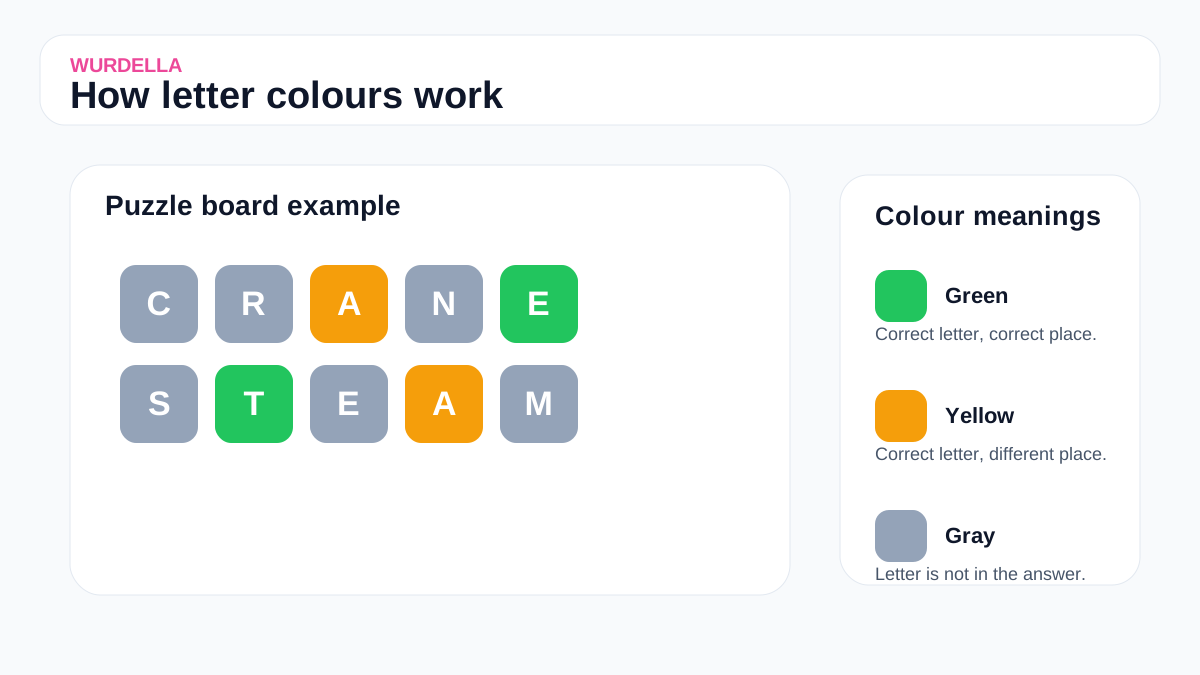
Rounds 1–2: learn what every tile proves
Green confirms both the letter and its exact position. Yellow confirms the letter but rejects the position where you tried it. An incorrect tile normally removes that character from consideration, although repeated-letter guesses can make quantity important.
Do not rush to memorize strategies before these meanings are automatic. A beginner who reads every tile correctly will improve faster than one who knows ten famous opening words but ignores the feedback.
Worked examples
- • Green A in position two: keep A there in later answer candidates.
- • Yellow R in position one: R is required, but position one is no longer legal for it.
Rounds 3–4: make the second guess respond to the first
A good first guess is wasted if row two follows a memorized script that ignores the board. Preserve greens, move yellows and introduce useful unused letters. If row one is almost entirely gray, broader coverage makes sense; if it already reveals a strong pattern, start solving sooner.
The second guess should answer a question created by the first row. That habit is more important than finding one universal starter.
- ✓ Keep confirmed positions.
- ✓ Move required yellow letters.
- ✓ Avoid clearly excluded letters.
- ✓ Test useful new letters only when the pattern is still broad.
Rounds 5–6: stop guessing words that contradict the board
Before typing, turn the board into a small checklist: fixed positions, required letters, rejected yellow positions and excluded characters. Then reject any candidate that violates even one rule.
This is where many beginner losses happen. The final guess looks like a reasonable English word, but one yellow has returned to a failed square or a gray letter has quietly been reused.
Rounds 7–8: learn when the clue is actually useful
Wurdella offers one clue during rows 1–3. The clue carries a scoring cost, so the best time to use it is when meaning-based help can genuinely shrink a set of legal candidates.
Do not use it simply because the word feels hard. First explain what the board already proves. If one obvious answer remains, save the points; if several unfamiliar words still fit, the clue can be a smart rescue.
Rounds 9–10: review one mistake instead of the whole loss
After a difficult round, find the first avoidable mistake: moved green, repeated yellow position, reused excluded letter, ignored duplicate possibility or low-information probe. Fixing one specific habit is more useful than staring at the final answer and deciding you simply did not know the word.
At the end of ten rounds, the real milestone is whether your process has become predictable: read the board, build constraints, choose a useful next guess, review the first mistake.
Worked examples
- • A useful review note: 'Row 3 reused T even though T was already excluded.'
- • A weaker review note: 'The word was hard.'
Treat each row as a small experiment
The fastest way to improve is to stop judging a guess only by whether it looks close to the answer. A useful row tests something specific: a new vowel, a likely ending, a yellow letter in a fresh position or several letters that distinguish one candidate family from another. Even an all-gray row can be excellent if it eliminates five strong possibilities at once.
Before pressing Enter, ask what you expect to learn from the word if it is wrong. If the answer is 'not much,' the guess is probably too decorative. Beginners often lose rows because a word feels plausible, not because it creates a good next decision.
Worked examples
- • If your first row gives one green and four misses, a good second row keeps the green and tests four useful unused letters.
- • If two yellows are already known, a good guess relocates both instead of placing one back in a rejected position.
Know the three mistakes beginners repeat most
The first common mistake is moving a green letter. The second is returning a yellow letter to a position that already failed. The third is reusing a clearly excluded character because the new word happened to come to mind quickly. These are not vocabulary problems; they are board-reading problems.
A short pause before every guess fixes most of them. Read the current pattern left to right, say the required letters, then list the characters you should not use. This takes seconds and usually saves an entire row.
- ✓ Keep greens fixed unless you are deliberately probing.
- ✓ Move every yellow away from rejected positions.
- ✓ Do not recycle excluded letters without a duplicate-letter reason.
- ✓ Check whether the answer could contain a repeated letter.
Use rows one, two and three differently
Row one should usually gather broad information. Row two should respond to row one instead of following a memorized script. By row three, the board should begin to look like a constrained pattern, and that is often the moment to stop collecting letters and start comparing realistic answers.
Wurdella also makes the clue available only during the early rows, so row three is a natural decision point: either the board already contains enough information, or meaning-based help could prevent the puzzle from becoming a blind late-round guess.
Use the Word Finder after a round to train pattern recognition
The Word Finder is most useful for learning after a difficult board. If you repeatedly miss words ending in a particular letter or struggle when a vowel is fixed in the second position, open the matching pattern page and study the actual candidate family.
This keeps the live puzzle honest while still turning mistakes into practice. Over time, endings and letter-position patterns that once required a search become shapes you recognize immediately.
A beginner progress checklist for the first ten rounds
After ten rounds, do not ask only how many you won. Check whether you are still moving greens, whether yellow positions are being remembered, how often you reuse excluded letters and whether the clue is used because it is necessary or because you feel impatient.
A player who solves six of ten rounds with disciplined board reading is building a stronger base than a player who wins eight through lucky openers and repeated guessing. The goal of the first ten rounds is a routine you can trust when the words become harder.
- ✓ I can explain every green and yellow before guessing.
- ✓ My second guess reacts to the first row.
- ✓ I recognize when to stop probing and start solving.
- ✓ I review one avoidable mistake after a loss.
- ✓ I use clues deliberately rather than automatically.
Next step
Use the guide on a real board
Try the guide on a real board in unlimited play, compare actual word patterns in the Word Finder or use Challenge a Friend when the guide is about competitive play.