Kids: four-letter spelling and pattern practice
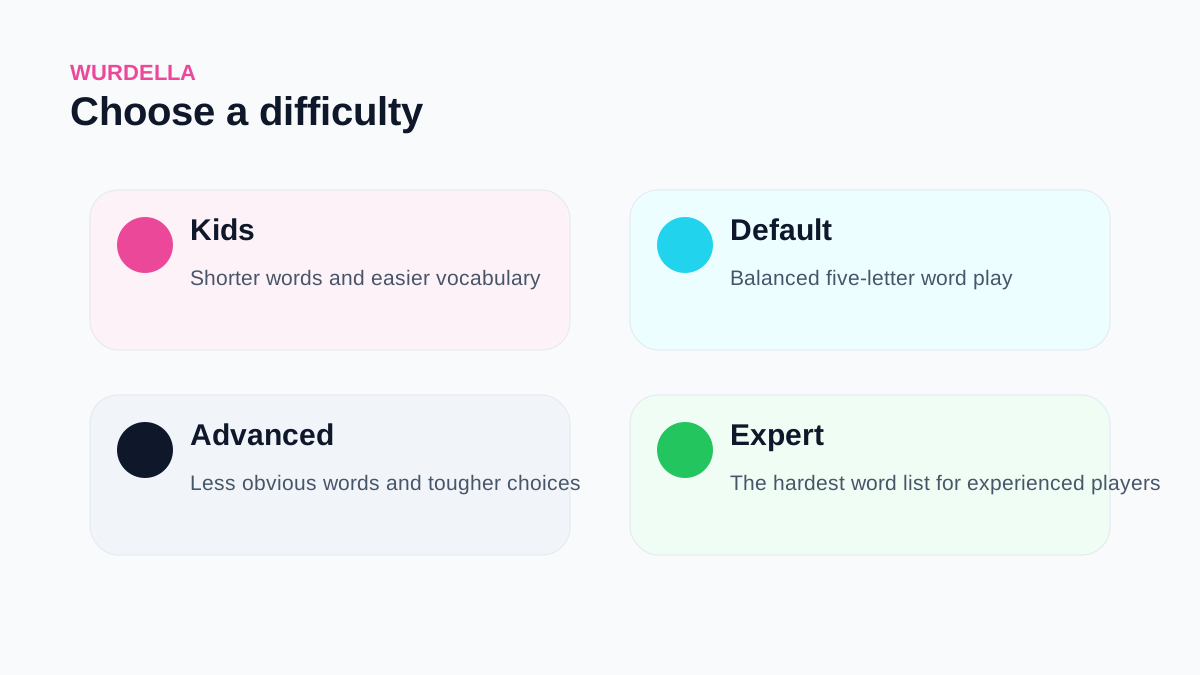
Kids reduces the board to four letters, which makes positions easier to track and gives younger players a clearer connection between one tile and the next decision.
It is also useful for families, English learners and anyone who wants a lighter round. The mode should be treated as a different challenge, not as a level a player is embarrassed to return to.
Default: the best starting point for most five-letter players
Default uses accessible five-letter vocabulary and gives enough variety to teach openings, yellow placement and repeated-letter logic without relying heavily on obscure words.
If you are comparing strategies, Default is a useful baseline because the vocabulary is less likely to overwhelm the decision process.
Advanced: less obvious vocabulary and tighter patterns
Advanced increases the chance that familiar word recall will not be enough. Players need to rely more heavily on exact constraints, candidate families and careful use of every row.
A good sign you are ready is that Default losses usually come from reasoning mistakes rather than from struggling to generate any plausible words.
Expert: deliberately difficult vocabulary
Expert is designed for experienced players who want unfamiliar, technical or uncommon vocabulary to become part of the challenge. A solve may come from pattern logic before the player knows the exact meaning.
Definitions and pronunciation support are especially useful here because an unfamiliar result can become a vocabulary discovery instead of merely a strange sequence of letters.
Why scores should be compared inside the same difficulty
The point system may award the same round value across levels, but the underlying vocabulary challenge is different. A ten-point Kids solve and a ten-point Expert solve should not be treated as identical evidence of difficulty.
For personal improvement, compare solve rate, clue use and average guesses within one level over several rounds.
How clues feel different across levels
In Kids or Default, the board often provides enough familiar vocabulary to skip the clue. In Advanced and Expert, meaning-based help can be more valuable because several pattern-valid words may be unfamiliar.
The scoring cost stays strategic: use the clue when it changes the candidate list, not simply because the word feels hard.
How multiplayer difficulty should be chosen
Use one level for every player in the same competitive match. Default is the safest choice for mixed friend groups, while Kids works for younger families and Advanced or Expert suits experienced players.
For team play, choose the level that keeps everyone able to contribute. A difficulty that turns half the team into spectators is usually too high.
Move up gradually and move down without hesitation
Play several rounds at one level before deciding. One easy answer does not prove the level is too simple, and one brutal answer does not prove it is too hard.
Difficulty is a setting, not a status symbol. Switching down can be the smartest way to practice a weak solving habit before returning to a harder word bank.